
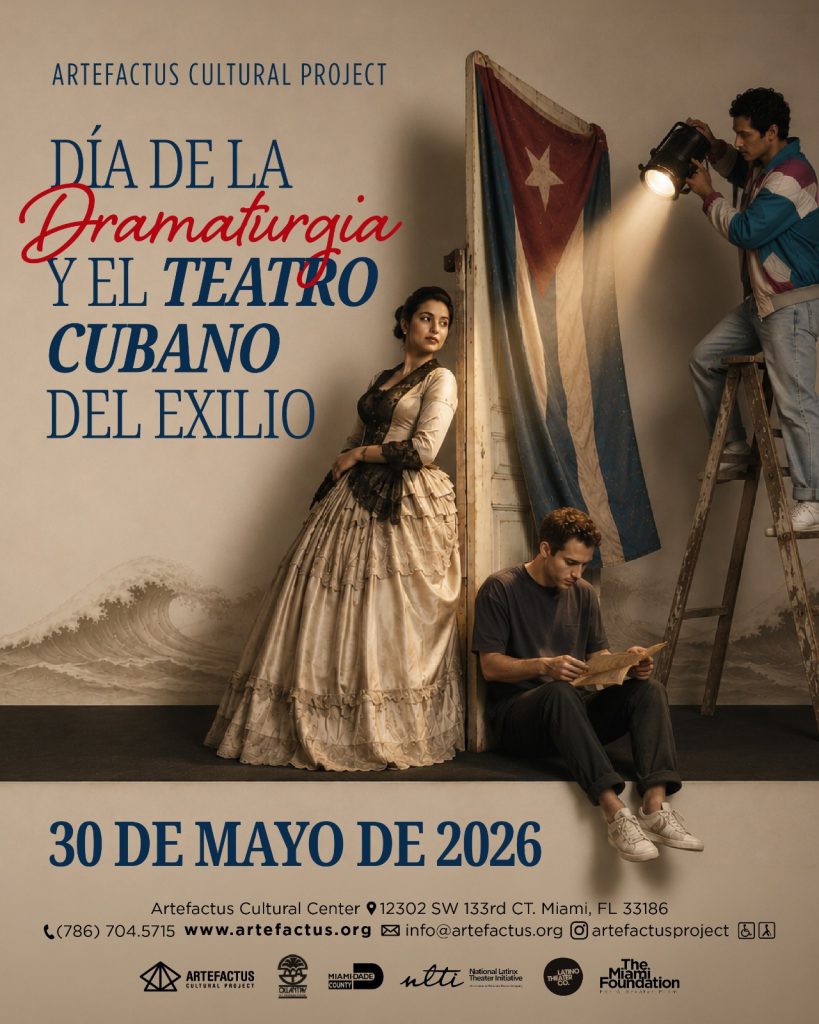
Every May 30th, we celebrate Cuban Exile Dramaturgy and Theater Day, an event created in 2013 by Pedro Monge Rafuls (Ollantay Center for the Arts, New York) and Eddy Díaz-Souza (ARTEFACTUS Cultural Project, Miami) to recognize and highlight Cuban drama written and developed outside of Cuba. The date was chosen to pay tribute to the distinguished professor, researcher, and theater critic José A. Escarpanter, who passed away on May 30, 2011, and is considered the first great scholar of Cuban drama written in the diaspora. His work paved essential paths for understanding, documenting, and legitimizing a fundamental part of Cuban theatrical culture developed outside the island. Since its inception, this celebration has sought to recognize the work of dramaturgy, actors, directors, researchers, and theater companies who, from exile and geographical dispersion, have contributed to sustaining a vibrant, diverse theater scene deeply connected to the contemporary Cuban experience.
Cuban exile theater has been a territory of creative resistance, but also of aesthetic renewal, cultural dialogue, and a constant search for new forms of expression. Across generations, cities, languages, and historical contexts, its creators have developed a dramatic tradition imbued with memory, displacement, identity, political violence, nostalgia, reinvention, and the need to continue telling stories beyond borders.
Over the years, the Day of Cuban Exile Dramaturgy and Theater has also contributed to consolidating spaces for the promotion and visibility of this theatrical tradition through staged readings, publications, panels, tributes, research, and performances, strengthening the dialogue between artists and communities scattered across the globe.
Beyond labels or divisions, this day recognizes theater’s capacity to preserve memory, question reality, and build bridges between generations, languages, and human experiences. Celebrating this day of Cuban dramaturgy and theater in exile is also celebrating the persistence of an artistic community that has been able to transform loss and displacement into creation, thought, and scenic beauty.